What if a small piece of dark chocolate could actually support your workout instead of just satisfying a craving?
It might sound surprising, but dark chocolate contains compounds that can influence blood flow, energy levels, and how your body responds to exercise. This is why it has started gaining attention as a potential pre-workout snack. At the same time, it is not a magic solution, and its role is often misunderstood. The real impact depends on how much you eat, when you eat it, and what you pair it with.
In this guide, we break down what dark chocolate actually does in your body, what science says about its effect on performance, and how to use it the right way before a workout.
Why Dark Chocolate Is Considered for Pre-Workout

The workout-related benefits of dark chocolate mainly come from a compound called epicatechin. It is a natural flavanol found in cacao that plays a key role in how your body responds to physical activity.
During exercise, epicatechin supports several important functions in the body.
- It helps increase the production of nitric oxide, which allows blood vessels to relax and improves blood flow. This makes it easier for oxygen to reach your muscles, especially during movement.
- It also supports mitochondrial function, which is important for energy production at a cellular level. Better mitochondrial efficiency means your muscles can use energy more effectively during activity.
- In addition, epicatechin acts as an antioxidant, helping reduce the oxidative stress that builds up during intense exercise.
In simple terms, it helps prepare your body for movement by supporting circulation and energy use. Since epicatechin is directly linked to cocoa content, choosing dark chocolate with at least 70 percent cacao ensures you are actually getting these benefits.
What Does the Research Actually Show
Dark chocolate has been studied for its potential impact on exercise performance, but the results are more modest than many fitness articles suggest. While there is some promising evidence, it is important to understand what these studies actually show and where the limitations lie.
1. One of the most commonly cited studies comes from researchers at Kingston University, where participants consumed around 40 grams of dark chocolate daily for two weeks. When tested, they showed small improvements in certain performance markers compared to a control group.
Some participants were able to sustain slightly higher intensity levels during short exercise tests, which researchers linked to improved blood flow and oxygen delivery. However, these findings came from a small sample size and short duration, which means they cannot be applied broadly to all individuals or training conditions.
2. Dark chocolate is often compared to beetroot juice because both can influence nitric oxide levels in the body, which helps improve circulation. However, the effect is not equal. Beetroot juice has much stronger and more consistent evidence supporting its performance benefits, while the effects of dark chocolate are milder and less predictable.
3. More recent research has explored its role in sprint performance and short-duration exercise, with some studies suggesting small improvements. However, these changes are typically minimal and may not have a meaningful impact outside of controlled conditions.
4. One area where the evidence is clearer is what dark chocolate does not do. Current research does not support a significant improvement in VO2 max, which is a key indicator of aerobic fitness. While some studies show slight positive trends, the overall data is not strong enough to confirm a real effect.
5 Benefits of Eating Dark Chocolate Before a Workout
1. Slight Boost in Short Bursts of Performance

Some small studies suggest that dark chocolate may help you perform slightly better in short, high-intensity efforts like sprints or intervals.
This is likely due to improved blood flow, not a direct energy boost. The effect is real, but small, and won’t replace proper training or nutrition.
2. Helps You Hold Intensity a Bit Longer
Dark chocolate may delay fatigue slightly by improving oxygen delivery to muscles. In simple terms, you might be able to push a little longer before you start feeling exhausted. The difference is subtle, not game-changing.
3. Supports Your Body During Training
Exercise creates stress in your muscles at a cellular level. Dark chocolate contains flavanols that help your body handle this stress better. This doesn’t instantly improve recovery, but it supports your system over time if your diet is consistent.
4. Gives Smooth, No-Crash Energy
Dark chocolate contains:
- a small amount of caffeine
- theobromine (a slower, milder stimulant)
Together, they give a steady, calm energy boost without the sharp spike and crash you get from strong pre-workouts.
5. Improves Your Mood Before Training
Dark chocolate can slightly improve mood and motivation. That matters more than it sounds. Going into a workout feeling focused and positive can directly affect how well you train.
Limitations of Dark Chocolate as a Pre-Workout
Despite these benefits, dark chocolate has clear limitations when it comes to workout nutrition.
It does not provide enough fast-acting carbohydrates, which are the primary source of energy for high-intensity exercise. Your body needs quick fuel before demanding workouts, and dark chocolate simply does not deliver that efficiently. It is also high in fat, which slows down digestion. This means the energy release is delayed, making it less suitable if consumed shortly before a workout. In some cases, it may even feel heavy or uncomfortable. Most importantly, its impact on actual performance is limited. While improved blood flow sounds beneficial, it does not translate into significant gains in strength, speed, or endurance when compared to proper pre-workout nutrition.
When Does Dark Chocolate Work Best?
Dark chocolate works best for lighter forms of exercise where energy demands are not very high.
It can be useful before activities such as yoga, walking, stretching sessions, or short workouts where you mainly need a small boost in focus and energy rather than intense fuel.
When It Does Not Work Well
For more demanding workouts, dark chocolate is not an ideal choice on its own.
It is not suitable before strength training, high-intensity interval training, or endurance workouts, where your body requires quick and sustained energy from carbohydrates. In these cases, relying only on dark chocolate may leave you feeling low on energy during the session.
Best Time to Eat Dark Chocolate Before a Workout
Timing plays an important role in how your body uses dark chocolate. It is best consumed around one and a half to two hours before exercise. This gives your body enough time to digest the fats and absorb the beneficial compounds. Eating it too close to your workout may lead to discomfort or sluggishness.
How Much Dark Chocolate Should You Eat?
A portion of about 20 to 30 grams is sufficient. This provides the benefits of its active compounds without adding excess calories or fat.
Eating more will not improve performance and can make digestion slower, which is counterproductive before exercise.
What Kind of Dark Chocolate Should You Choose?
You won't get any of these benefits from the wrong type of chocolate. Here's what to check on the label:
✅ Look for:
- 70% cacao or higher on the front of the pack
- Cacao mass or cocoa solids listed as the first ingredient
- A short, clean ingredient list (5 or fewer ingredients)
- No mention of "processed with alkali" or "alkalized cocoa" - this process destroys most of the flavanols that make dark chocolate effective
❌ Avoid:
- Milk chocolate or white chocolate - no meaningful epicatechin content
- Bars with milk solids, vegetable oil, or palm oil
- Anything with artificial flavourings or sweeteners
- "Dark flavoured" chocolate - a marketing term with no regulated cacao minimum
How to Make Dark Chocolate a Better Pre-Workout Snack
Dark chocolate works best alongside (not instead of) your regular pre-workout food:
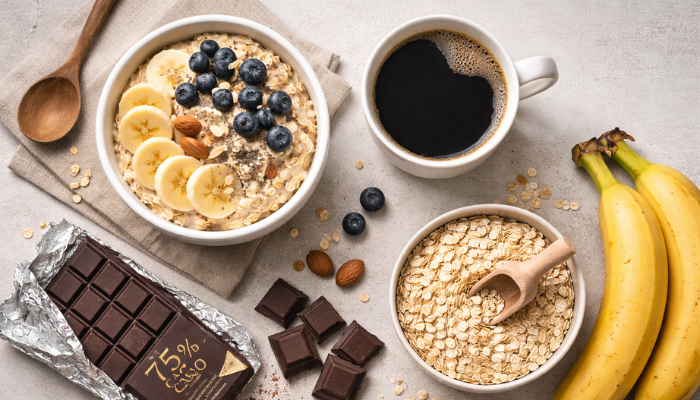
- Running or cycling: Oats or a banana 90 minutes before training + 30 - 40g dark chocolate 60 minutes before. Carbs fuel your glycogen stores; dark chocolate handles the nitric oxide and antioxidant work.
- Gym and HIIT: A light snack of Greek yoghurt or a handful of mixed nuts + 30-40g dark chocolate, 60 minutes before. The fat and protein slow the sugar release; the theobromine and caffeine sharpen your focus.
- Early morning training: 30-40g dark chocolate with black coffee 45-60 minutes before. A natural, food-based pre-workout stack that covers energy, focus, and blood flow without synthetic ingredients.
Dark Chocolate vs Other Pre-Workout Foods
|
Food |
Energy Type |
Digestion Speed |
Best Use |
|
Banana |
Fast carbohydrates |
Quick |
High-intensity workouts |
|
Oats |
Complex carbohydrates |
Moderate |
Sustained energy |
|
Coffee |
Stimulant |
Fast |
Focus and alertness |
|
Dark Chocolate |
Fat + mild stimulant |
Slow |
Light workouts |
This comparison shows that dark chocolate is not a replacement for traditional pre-workout foods, but it can complement them.
Who Should Avoid Dark Chocolate Before a Workout
Dark chocolate may not be suitable for everyone.
- If you are sensitive to caffeine, the ~30–40mg in a 40g serving is modest but may cause mild jitteriness during intense training
- If you are in a calorie deficit, factor in the ~240 kcal per 40g serving in your daily intake
- If you have digestive issues, the fat content may cause discomfort during very intense workouts — eat it slightly earlier or reduce to 20–25g
Common Myths About Dark Chocolate as a Pre-Workout
There is a common belief that dark chocolate significantly boosts workout performance. In reality, its effect is mild and mostly indirect. Another misconception is that it works like a pre-workout supplement. The caffeine content in dark chocolate is much lower than coffee or commercial pre-workout products, so the impact is not comparable.
It is also often assumed that eating more chocolate provides more energy, which is not true. Higher intake only increases fat and calorie consumption without improving performance.
Final Verdict
Dark chocolate can be a useful addition to your pre-workout routine, but it should not be treated as a primary source of energy. It works best as a small supporting snack, especially for lighter workouts. For more intense sessions, combining it with carbohydrate-rich foods is a more effective approach.



How much dark chocolate should I eat before a workout?
30–40g of 70%+ non-alkalized dark chocolate, about 60 minutes before training. Consistent daily consumption over two weeks produces better results than eating it only on workout days .
Does dark chocolate give energy for workouts?
It provides a mild energy boost, but not enough for high-intensity exercise on its own.
Is dark chocolate better than coffee before a workout?
No, coffee provides a stronger and faster stimulant effect compared to dark chocolate.
Can I use dark chocolate instead of a pre-workout supplement?
It is not a direct replacement for supplements containing creatine or beta-alanine. But as a natural, food-based performance booster — particularly for endurance, sprint capacity, and focus — it is one of the best-evidenced options available.
When is the best time to eat dark chocolate before a workout?
About 60 minutes before training — enough time for the flavanols to absorb and nitric oxide levels to rise, and for the theobromine and caffeine to be in full effect when you begin your warm-up.
Is dark chocolate better than beetroot juice before a workout?
Both improve nitric oxide and sprint performance through different pathways. Dark chocolate wins on palatability, availability, and overall nutrition profile. Beetroot juice has an edge for VO2 max research. For most gym-goers, dark chocolate is the more practical everyday option.